Find a Physician
Return to Anatomy and Function of the Heart Valves Overview
More on Anatomy and Function of the Heart Valves
Clinical Services
Return to Anatomy and Function of the Heart Valves Overview
More on Anatomy and Function of the Heart Valves
- About Single Ventricle Defects
- Cardiac Surgery
- Cardiology
- Cardiopulmonary Exercise Laboratory
- Cardiovascular Genetics Research
- Catheterization Laboratory Research
- Congenital Heart Center Outcomes
- Contact Us
- Developmental Biology Research
- Electrophysiology Research
- Fellowship Program
- Fetal Cardiology Research
- Heart Failure and Cardiac Transplantation Research
- Interstage Surveillance Program
- In the News
- Make an Appointment
- Meet Our Team
- Non-Invasive Imaging Laboratory
- Non-Invasive Imaging Laboratory Research
- Our Compassionate Approach
- Our History of Leadership
- Our Patient Volume and Experience
- Our Research Commitment
- Our Specialized Programs
- Outcomes
- Patient Stories
- Pediatric Cardiac Catheterization Laboratory
- Pediatric Cardiopulmonary Laboratory Research
- Pediatric Heart Network Research
- Preventive Cardiology Program
- Pulmonary Hypertension Comprehensive Care Center
- Pulmonary Hypertension Research
- Resources for Parents
- The Center for Single Ventricle Care
- What to Expect
- Why Choose Us
- Why Choose Us for Your Child's Care
- Your Child's Healthcare Team
Health Information
Return to Anatomy and Function of the Heart Valves Overview
More on Anatomy and Function of the Heart Valves
Research and Clinical Trials
Return to Anatomy and Function of the Heart Valves Overview
More on Anatomy and Function of the Heart Valves
For Patients, Families & Visitors
Return to Anatomy and Function of the Heart Valves Overview
More on Anatomy and Function of the Heart Valves
Professionals
Return to Anatomy and Function of the Heart Valves Overview
More on Anatomy and Function of the Heart Valves
Hospital News
Return to Anatomy and Function of the Heart Valves Overview
More on Anatomy and Function of the Heart Valves
Anatomy and Function of the Heart Valves
Anatomy and Function of the Heart Valves
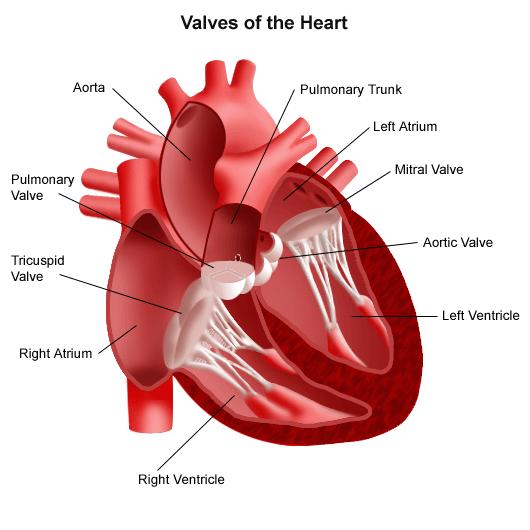
What are heart valves?
The heart consists of four chambers, two atria (upper chambers) and two ventricles (lower chambers). Blood passes through a valve before leaving each chamber of the heart. The valves prevent the backward flow of blood. Valves are actually flaps (leaflets) that act as one-way inlets for blood coming into a ventricle and one-way outlets for blood leaving a ventricle. Normal valves have three flaps (leaflets), except the mitral valve, which only has two flaps. The four heart valves include the following:
- tricuspid valve - located between the right atrium and the right ventricle.
- pulmonary valve - located between the right ventricle and the pulmonary artery.
- mitral valve - located between the left atrium and the left ventricle.
- aortic valve - located between the left ventricle and the aorta.
How do the heart valves function?
As the heart muscle contracts and relaxes, the valves open and shut, letting blood flow into the ventricles and atria at alternate times. The following is a step-by-step description of how the valves function normally in the left ventricle:
- When the left ventricle relaxes, the aortic valve closes and the mitral valve opens, to allow blood to flow from the left atrium into the left ventricle.
- The left atrium contracts, allowing even more blood to flow into the left ventricle.
- When the left ventricle contracts, the mitral valve closes and the aortic valve opens, so blood flows into the aorta.
What is heart valve disease?
Heart valves can have one of two malfunctions:
- regurgitation
The valve(s) does not close completely, causing the blood to flow backward instead of forward through the valve. - stenosis
The valve(s) opening becomes narrowed or valves become damaged or scarred (stiff), inhibiting the flow of blood out of the ventricle or atria. The heart is forced to pump blood with increased force in order to move blood through the narrowed or stiff (stenotic) valve(s).
Heart valves can have both malfunctions at the same time (regurgitation and stenosis). Also, more than one heart valve can be affected at the same time. When heart valves fail to open and close properly, the implications for the heart can be serious, possibly hampering the heart's ability to pump blood adequately through the body. Heart valve problems are one cause of heart failure.
Click here to view the
Online Resources of Cardiovascular Disorders