Find a Physician
Return to Anatomy and Function of the Heart's Electrical System Overview
More on Anatomy and Function of the Heart's Electrical System
Clinical Services
Return to Anatomy and Function of the Heart's Electrical System Overview
More on Anatomy and Function of the Heart's Electrical System
- Arrhythmia Management and Electrophysiology Services
- Cardiac Surgery
- Cardiology
- Cardiopulmonary Exercise Laboratory
- Cardiovascular Genetics
- Catheterization Laboratory
- Congenital Heart Center Outcomes
- Contact Us
- Developmental Biology
- Electrophysiology
- Fellowship Program
- Fetal Cardiology
- Heart Failure and Cardiac Transplantation
- In the News
- Non-Invasive Imaging Laboratory
- Pediatric Cardiac Catheterization Laboratory
- Pediatric Cardiopulmonary Laboratory
- Pediatric Heart Network
- Pediatric Heart Transplant Program
- Preventive Cardiology Program
- Pulmonary Hypertension
- Pulmonary Hypertension Center
- Why Choose Us for Your Child's Care
Health Information
Return to Anatomy and Function of the Heart's Electrical System Overview
More on Anatomy and Function of the Heart's Electrical System
Research and Clinical Trials
Return to Anatomy and Function of the Heart's Electrical System Overview
More on Anatomy and Function of the Heart's Electrical System
For Patients, Families & Visitors
Return to Anatomy and Function of the Heart's Electrical System Overview
More on Anatomy and Function of the Heart's Electrical System
Professionals
Return to Anatomy and Function of the Heart's Electrical System Overview
More on Anatomy and Function of the Heart's Electrical System
Hospital News
Return to Anatomy and Function of the Heart's Electrical System Overview
More on Anatomy and Function of the Heart's Electrical System
Anatomy and Function of the Heart's Electrical System
Anatomy and Function of the Electrical System
The heart's electrical system:
The heart is, in the simplest terms, a pump made up of muscle tissue. Like all pumps, the heart requires a source of energy in order to function. The heart's pumping action comes from a built-in, electrical, conduction system.
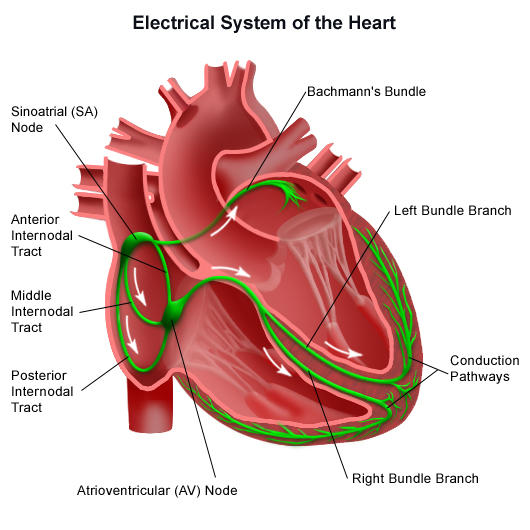
How does the heart beat?
An electrical stimulus is generated by the sinus node (also called the sinoatrial node, or SA node), which is a small mass of specialized tissue located in the right atrium (right upper chamber of the heart). The sinus node generates an electrical stimulus periodically (60-190 times per minute, depending on the age of the child and his/her activity level). This electrical stimulus travels down through the conduction pathways (similar to the way electricity flows through power lines from the power plant to your house) and causes the heart's lower chambers to contract and pump out blood. The right and left atria (the two upper chambers of the heart) are stimulated first and contract a short period of time before the right and left ventricles (the two lower chambers of the heart).
The electrical impulse travels from the sinus node to the atrioventricular (AV) node, where impulses are slowed down for a very short period, then continues down the conduction pathway via the bundle of His into the ventricles. The bundle of His divides into right and left pathways to provide electrical stimulation to both ventricles.
Normally, as the electrical impulse moves through the heart, the heart contracts about 60 to 100 times a minute. Each contraction of the ventricles represents one heartbeat. The atria contract a fraction of a second before the ventricles so their blood empties into the ventricles before the ventricles contract.
Under some conditions, almost all heart tissue is capable of starting a heartbeat, or becoming the "pacemaker," just like the sinus node. An arrhythmia (abnormal heartbeat) may occur when:
- the heart's natural pacemaker (the sinus node) develops an abnormal rate or rhythm.
- the normal conduction pathway is interrupted.
- another part of the heart takes over as pacemaker.
Click here to view the
Online Resources of Cardiovascular Disorders